X


My First Text in Print!
There are moments in a writer’s life that feel slightly unreal. Seeing your name in print for the first time is one of them.
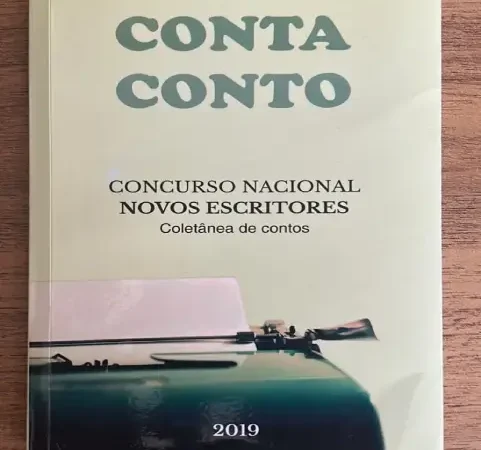
In 2018, I was awarded third place in a Brazilian national competition — the Concurso Nacional Novos Escritores — and my text was published in the anthology Conta Conto: Concurso Nacional Novos Escritores. It was the first time I had a piece of fiction printed in a book.
I remember holding the anthology and feeling a mixture of disbelief and quiet joy. My name was there. Not on a workshop draft. Not in a Word document. Not buried in a folder on my laptop. In print. In a book.
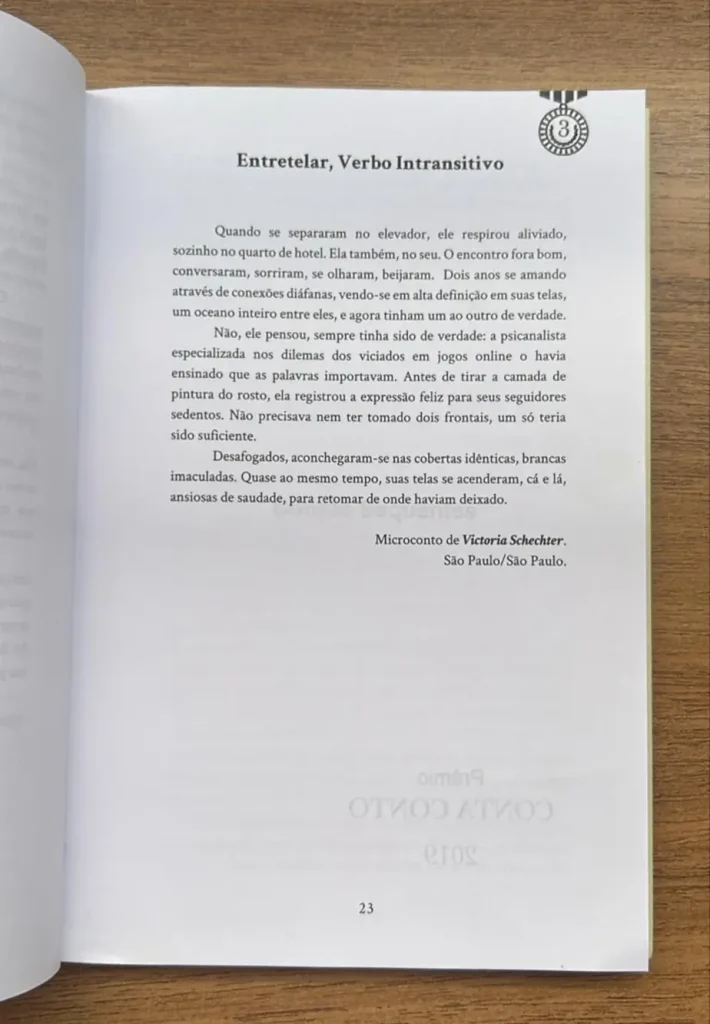
It was written and published in Portuguese, and the story is titled ‘Entretelar, Verbo Intransitivo’ — which I translated as ‘To Screen, an Intransitive Verb’.
The text is a flash fiction piece (what we call a micro-conto in Portuguese). It occupies barely half a page. And yet it took me far longer to write than many pieces ten times its length.
Flash fiction is an extremely compressed narrative form. There is no room for scaffolding, no space for elaborate backstory, no tolerance for unnecessary words. Every sentence must carry weight. Often, what remains unsaid is as important as what appears on the page.
It is not a form I naturally gravitate towards. I am far more comfortable writing essays, novels, or even longer short stories of 5,000 words. I like room to breathe. I like layered structures, digressions, and slow unfolding. Compression does not come instinctively to me.
Which is precisely why I decided to attempt it.
I wrote ‘Entretelar, Verbo Intransitivo’ during a Creative Writing Summer School at Oxford — an experience I will write about another time. At the time, I set myself the challenge of working in a form that felt restrictive. I wanted to see what would happen if I forced myself to cut relentlessly, to reduce the narrative to its essential gestures.
What surprised me was not how short the final piece became, but how long it took to get there.
When you only have half a page, there is nowhere to hide. Every adjective becomes suspect. Every clause must justify its existence. Rhythm becomes structural. The ending must reverberate backwards through the text. A flash fiction piece is less about plot than about tension — about suggestion, resonance, and precision.
That small text demanded extraordinary discipline.
And then it won third place.
I remember feeling both proud and slightly disbelieving. Was I allowed to call myself a writer now? Did this make it official?
Of course, legitimacy does not truly arrive with publication. But seeing one’s name in print does something profound. It materialises what was once private. It gives it weight.
The anthology cover will appear as the main image of this post. Below, I have included a scanned page of the published text so that you can read it exactly as it appeared in the book.
Looking back, I see this publication as a threshold moment — small in scale, but decisive in meaning. It marked the first time I crossed from private practice into public authorship.
I am still not primarily a writer of short forms. I remain more at home in long essays, experimental novels, and layered narratives. But I am grateful for this flash fiction piece. It forced me into precision. It sharpened my attention. And it gave me the unforgettable experience of seeing my name in print for the first time.
That feeling — half disbelief, half quiet certainty — has stayed with me ever since.