
X


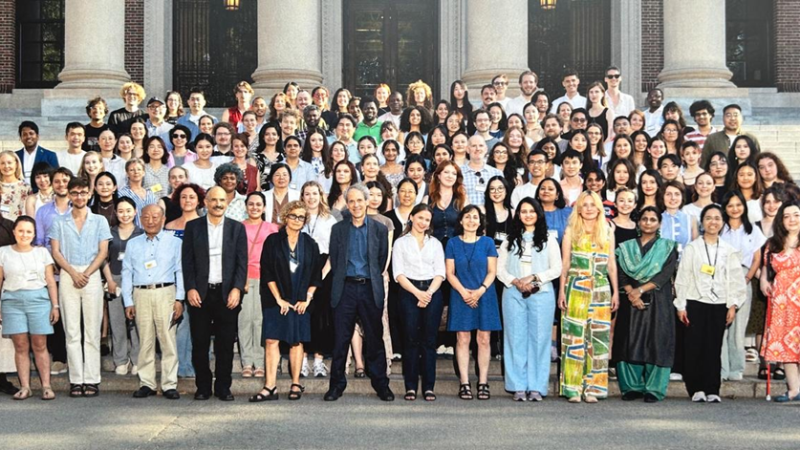
During the four weeks of July 2025, I took part in the Institute for World Literature (IWL), an international summer programme based at Harvard University. The IWL brings together researchers from around the world for an intensive month of seminars, lectures and colloquia, creating a rather singular space of intellectual exchange — intense, demanding and, at the same time, profoundly formative from an academic perspective.
As part of the programme, I attended two seminars that speak directly to my doctoral research. The first was ‘Multilingualism as Critique’ (Multilingualismo como Crítica), led by Matylda Figlerowicz, which explored multilingualism as a critical practice capable of unsettling literary canons, regimes of translation and hegemonic modes of reading. The second, ‘The Undiscovered Country’ (O País a ser Descoberto), with Delia Ungureanu, examined literary and intellectual projects that imagined new configurations of country, belonging and future in contexts of historical crisis. They were intellectually dense, stimulating seminars conducted with great generosity.
In addition to the classes, I took part in an IWL colloquium, where I presented my research and served as session leader. A colloquium is a structured space for academic discussion: each participant presents work in progress, followed by comments and collective debate. Leading a session involves organising time, moderating the conversation and encouraging productive critical exchange among people from very different backgrounds and traditions — something I consider an extremely enriching experience.
The IWL cohort was, without exaggeration, extraordinary. There were people from every continent, with very different trajectories, and I even met someone from Tibet. At the same time, I felt the absence of a more substantial presence of Latin American and African researchers — an absence that becomes particularly visible in a programme that positions itself as global.
One of the most memorable moments of the month was the conversation with André Aciman, who joined the IWL for an open talk. It was, honestly, one of the most extraordinary lectures I have ever attended — not only because of the content, but because of the generous, intelligent and deeply human way in which he spoke about literature, memory and writing.
On a personal level, however, the experience was marked by significant difficulties, especially in relation to accessibility. Despite the genuine goodwill of everyone involved in organising the programme, I encountered many obstacles navigating Harvard’s vast campus — something particularly challenging given my visual impairment.
In addition, I was unable to rely on the hearing loop provided by the university — an assistive listening system that transmits audio directly to hearing aids or cochlear implants, reducing background noise and improving speech clarity. I rely on the hearing loop as an essential tool, as I have an auditory processing impairment, and the system failed repeatedly, leaving me without adequate access to classes and lectures. I also observed a recurring practice of presumed adjustments — conceived as helpful, but implemented without consulting me — which at times further undermined my access. This experience reinforced something I have been reflecting on for some time: accessibility is not merely about building ramps or purchasing expensive equipment, but about listening and dialogue.
The month was also marked by intense heat, which was physically difficult to manage, and by a sense of social tension outside the programme. It is important to say that, within the IWL, everyone was extremely kind and welcoming. The tension I felt stemmed more from everyday life in the United States at that particular political moment — something that struck me even while being in Massachusetts, a state traditionally aligned with the Democratic Party.
In the end, the IWL was an intellectually rich and professionally significant experience, expanding networks, references and conversations that continue to resonate in my work. At the same time, it led me to reflect even more carefully on institutions, access and the limits between good intentions and effective inclusion. Like many intense academic experiences, it was made up of gains and frictions — and for that very reason, it has left lasting marks.
PS: There I am in the front row of the photo with the high-ups and Professors! They found it easier to place me there than to make me climb the stairs. Disabled perks!
