X


In April this year, I had the pleasure of leading a creative writing workshop for teenagers aged between 12 and 15, students from state schools in the Norfolk region, where the University of East Anglia (UEA) is based. UEA is particularly well known in the United Kingdom for its tradition in creative writing and for having trained authors who have achieved prominence in the contemporary literary market — and initiatives such as Live in Schools bring emerging readers even closer to living literature.
I must admit that I arrived feeling rather nervous. I do not have much experience working with teenagers, and I knew that maintaining the engagement of a group in this age range would not be simple. But I was pleasantly surprised: the students were deeply involved. During one of the central moments of the workshop — a longer writing activity — the room fell into complete silence for around twenty minutes, interrupted only by the sound of pencils scratching and rubbers erasing. Considering the age of the group, it was one of those moments when you realise that something has truly gone right. Modesty aside, I felt I had managed to design an activity that genuinely captured their interest.
The workshop formed part of UEA Live in Schools, a university outreach programme that invites primary and secondary school students to spend a day on campus. Throughout the day, students take part in author talks, question-and-answer sessions and practical workshops with writers, researchers and artists connected to the university and to the publishing world. The aim is twofold: to bring young people closer to contemporary literature and, at the same time, to demystify the university environment — particularly for state school pupils, for whom university may still seem distant or inaccessible.
On the day of the event, alongside the workshops, students attended talks by invited authors such as Lauren ‘Ren’ James and Ashley Hickson-Lovence. Lauren James is the author of the YA thriller Last Seen Online and other novels that have reached young readers across multiple publishers and territories, recognised for her engaging writing and relevance to teenage audiences. Ashley Hickson-Lovence is a British writer, novelist and Creative Writing lecturer, author of novels such as The 392, Your Show and Wild East — the latter written in verse and aimed at young readers, receiving strong critical attention and notable success with young audiences, as well as a prominent presence at literary festivals.
Seeing authors speak about their creative processes and respond directly to students’ questions brought remarkable vitality to the day and demonstrated how encounters with the people behind the books can inspire those who are just beginning to read and write.
The group assigned to me was relatively small — about nine students — which was ideal for encouraging interaction and, admittedly, made classroom management easier for me. The focus of the workshop was character creation, my favourite aspect of crafting narratives. We began with a short warm-up activity: an imaginary character speed-dating exercise (the students did not go on dates — their imagined characters did). Then we moved on to ‘what if’ writing prompts involving their character’s possessions. Finally, they had twenty minutes to write a scene in which their character lost a secret, prized possession.
I was astonished to see those students writing for a full twenty minutes, the classroom in complete silence except for pencils scratching and rubbers erasing. No chatting, no heads on desks. Perhaps British children between 11 and 14 are indeed better behaved than I remember from my own school days in Brazil at that age — but I prefer to believe that the workshop design genuinely engaged them. I later learned from the anonymous survey that one student said they felt like real UEA students!
Accessibility in the classroom was fundamental to ensuring that everything worked smoothly. I was accompanied by an undergraduate English student from the Student Ambassadors group, who support institutional events at the university. She was simply fantastic: she assisted me in navigating the campus, operated the slides during the workshop and — to my most moving surprise — participated in the activities alongside the students. Such a lovely young person. Watching that mediation unfold so naturally — someone there not merely helping, but actively writing alongside them — was so beautiful it nearly brought me to tears.
On that same day, several of my fellow PhD colleagues also led workshops, each bringing different perspectives on writing, critical reading and creativity. It was inspiring to see how our postgraduate community was able to offer such a rich variety of educational experiences to these young readers.
This year’s UEA Live in Schools programme was organised by my supervisor, Birgit Breidenbach — my true academic fairy godmother. Birgit has been a mentor to me since my Master’s degree, not only in a strictly academic sense, but also as a pedagogical inspiration. Observing closely the way she designs courses, conceives activities, connects people and makes complex projects viable is, for me, an ongoing and profoundly generous form of learning.
The day ended with me exhausted, yet energised — with that rare feeling that teaching, writing, research and encounter can indeed take place within the same gesture.
Unfortunately I don’t have any pictures of the day. That was pushed out of my mind because of the students’ image rights, but I could at least have one of the organisers and workshop leaders, or something like that. Anyway, that is imprinted in my memory as a happy day in our beautiful campus.
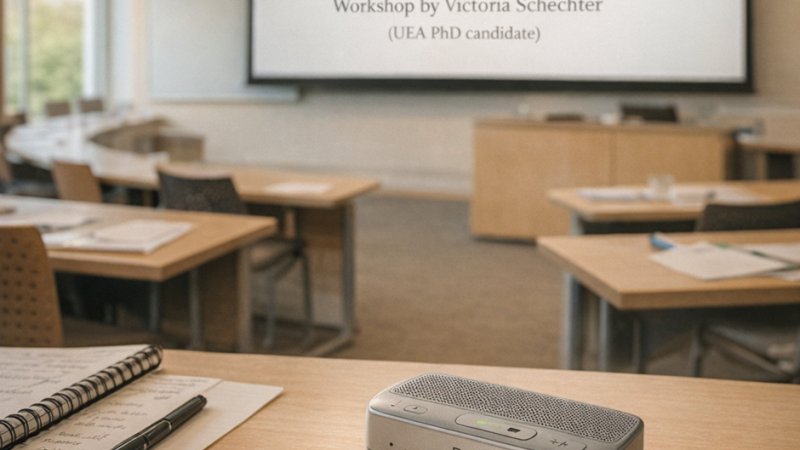
PS: The mic with controls you see in the picture is my Roger on mic, which helps me listen with more confidence. I talked about it on my post about my experience at Harvard in July. It’s the post before this one.
It’s not just about ramps or elevators.
Accessibility is in words, on websites, on the streets, in attitudes.
It’s in adding captions to a video.
It’s in describing an image.
It’s in allowing a blind person to read a text.
Or a deaf person to understand a lesson.
It’s in thinking about those who don’t see the world the way you do—and yet deserve to experience it fully.
It’s about clear language, empathetic communication, color contrast, sign language translations, tactile flooring, audio description, digital accessibility, and so many other ways to open up new paths.
? Lack of accessibility is exclusion in disguise.
When a website isn’t accessible, it excludes.
When content doesn’t have subtitles, it excludes.
When an event doesn’t have a sign language interpreter, it excludes.
And often, outsiders don’t even notice.
But insiders feel it—and remain silent out of exhaustion.
True inclusion only exists when accessibility is designed from the beginning.
Not as something to be adapted later, but as part of the project, the structure, the culture.
? Accessibility is a collective commitment.
Whether you’re a designer, a writer, a programmer, a teacher, a manager, an artist, or an ordinary citizen—you have a role.
We can all contribute to making the world more accessible.
And often, it’s simple gestures that open big doors:
Writing texts in plain language.
Use subtitles in videos and audio.
Consider the contrast between background and text.
Describe images for screen readers.
Avoid using colors alone to indicate information.
Listen to and learn from people with disabilities.
