
X


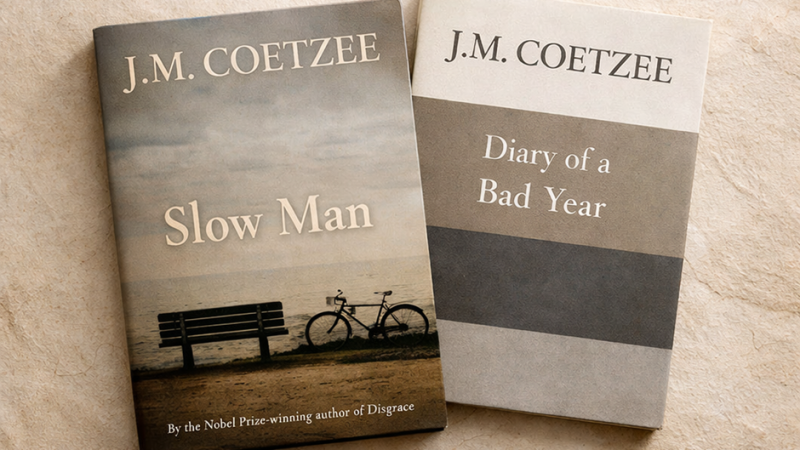
At the moment, I am deeply immersed in a text I have been writing with far more pleasure than I expected. It is a chapter of my PhD dedicated to two of J. M. Coetzee’s late novels — Slow Man and Diary of a Bad Year — and, in many ways, it has become a return to the starting point of the entire project.
Slow Man was one of the books that first made me want to think seriously about how stories can be shaped by bodies that do not easily fit into the world around them. Not only because the novel features a disabled protagonist, but because of the way the narrative moves: slowly, uncomfortably, refusing the satisfactions we have come to expect from fiction. Long before I had the language of theory, that resistance had already stayed with me.
What draws me most to these novels is the way they seem to struggle on the page itself. The stories hesitate, double back, fragment into multiple voices. In Diary of a Bad Year, the text is divided into layers, and reading becomes a physical act of navigation. In Slow Man, time stretches, stalls, and the narrative resists any easy arc of recovery or progress. These are books that do not rush to explain themselves — and that do not attempt to erase the discomfort they provoke.
Rather than treating this as a problem to be solved, my interest lies in considering what these unstable forms might tell us. For me, Coetzee’s late writing offers a way of thinking about disability and displacement not merely as themes, but as forces that shape the very structure of narrative. His characters are often out of place — geographically, socially, and bodily — and the novels mirror this sense of misalignment. The reading experience can be disorientating, yet also curiously intimate.
This is where the notion of ‘crip’ enters, which I keep in English. Like ‘queer’, it is a term reclaimed from insult and now used critically and politically to think about disability not as lack or tragedy, but as a mode of being that challenges norms of body, time, and productivity. When I speak of ‘crip’ forms, I refer to narratives that embrace slowness, dependency, interruption, and incompleteness as aesthetic and ethical choices.
One of the greatest pleasures of working on this chapter has been precisely allowing that disorientation to remain. These are books that refuse clarity, closure, and comfort. They ask us to stay with slowness, vulnerability, and uncertainty — qualities that are so often edited out of both fiction and everyday life. Writing about them has reminded me why I wanted to build a research project around form, fragility, and narrative resistance in the first place.
For now, I am content to remain with these texts: rereading them attentively, thinking through their silences and interruptions, and allowing them to continue shaping the way I understand writing. Sometimes, ‘news’ is not about something new, but about returning — with different eyes — to what first mattered.
